
Total disc replacement surgery removes a damaged or degenerated disc and replaces it with an artificial implant designed to preserve motion at that spinal segment, rather than eliminating it the way a fusion does. It can be performed in either the cervical spine (neck) or the lumbar spine (lower back), depending on where the disc damage is located. Candidates are typically patients with chronic lower back pain treatment or neck pain that hasn't responded to non-surgical care, and whose imaging shows disc degeneration without significant instability elsewhere in the spine.
Dr. Brett Taylor is a board-certified orthopedic spine surgeon practicing at Town & Country Crossing Orthopedics (TCCO) in St. Louis, Missouri. He evaluates each case individually to determine whether disc replacement, fusion, or another procedure is the appropriate course of treatment.
Attorneys and physicians working with a client or patient who may need this type of care can submit a referral to begin the review process.
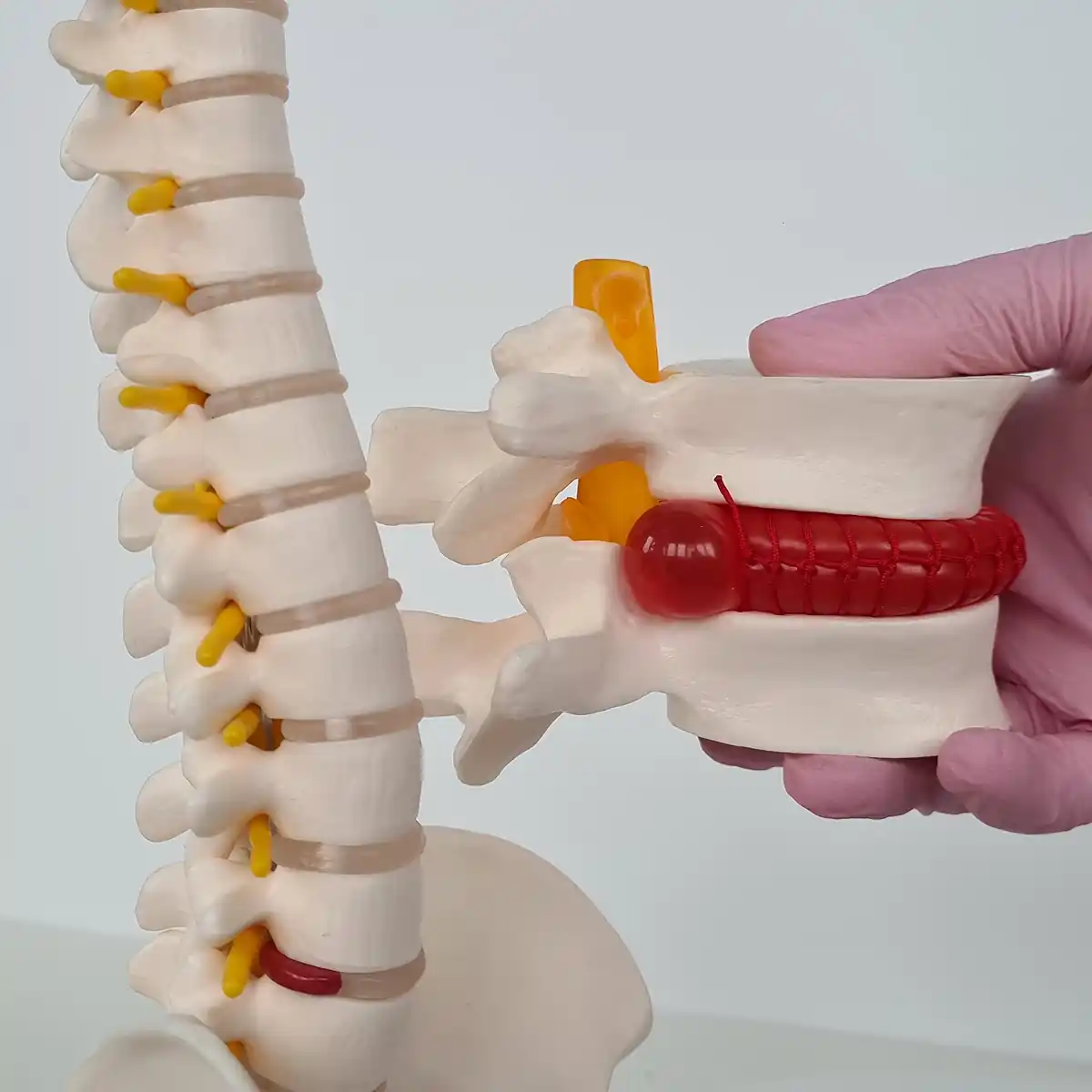
Spinal disc treatment with an artificial implant is available for both regions of the spine most prone to disc degeneration:
The main difference between disc replacement and fusion comes down to motion. A lumbar fusion or cervical fusion eliminates movement at the treated segment entirely, which can place additional stress on the adjacent, unfused levels of the spine over time. Disc replacement is designed to avoid that by preserving natural motion. Not every patient is a candidate for disc replacement, since it generally requires good bone quality and minimal instability elsewhere in the spine; patients who don't meet those criteria are typically better suited to fusion instead.
Total disc replacement surgery is most often recommended for:
Attorneys handling cases that involve a spinal disc diagnosis, and who need an independent medical opinion rather than a referral for treatment, can learn more about our expert witness and legal services.
Total disc replacement surgery cost varies based on whether the procedure is cervical or lumbar, the number of levels involved, and how the case is being billed, whether through workers' compensation, a personal injury claim, or another arrangement. Because TCCO's patient base is largely referral-based rather than direct-pay, cost is typically discussed and coordinated as part of the case rather than published as a flat rate. Attorneys and physicians with cost-related questions for a specific case are welcome to include that in their referral.
Good candidates for cervical disc replacement generally have disc degeneration limited to one or two levels, adequate bone quality, and no significant instability elsewhere in the cervical spine. Patients with more advanced arthritis, prior fusion at an adjacent level, or broader spinal instability are typically better suited to a fusion procedure instead. A full evaluation of imaging and clinical history is needed to determine candidacy for a specific case.
Dr. Brett Taylor is an artificial disc replacement surgeon in St. Louis, MO, with fellowship training in spine surgery and experience across both cervical and lumbar procedures. He evaluates and performs each surgery personally, working directly with referring attorneys and physicians throughout the case.
Referring physicians and attorneys can submit a referral describing the patient or client's diagnosis and relevant history to begin the review process. Once received, Dr. Taylor reviews the case to determine whether disc replacement, fusion, or another approach is the appropriate next step, and next steps are coordinated directly with the referring party.